2024 was a busy year for Rita Prisco, and for once, it wasn't just because of family life for the Queens, New York-based mom of 22-year-old triplets. Somehow, between serving up regular (and frequently viral) TikTok videos to her nearly 500,000 @cucinapalermo fans, she managed to publish not one but two cookbooks—Cucina Palermo: My Homemade Cookbook and Cucina Palermo: Savoring Sicily—and Piccola Francesca, which she envisions as the start of a children's book series.
It all began with a simple spaghetti recipe and a desire to present Sicilian cuisine authentically. She never imagined she'd be competing with professional chefs and cookbook authors. And that homemade approach has proved to be a winning formula.
Rita shared with me her connection to Sicily, how her incredible journey started, what makes a viral recipe, her future plans, what's been most rewarding, and more.
What is your connection to Sicily?
Both my parents are from Sicily. My father grew up in the city of Palermo. He passed away, but I have family in Balestrate, which is more of a beach area, so we would go there when I would go to Sicily. My mother's from a small town called Bisacquino, which is a couple of hours from Palermo. I also have family there still.
Can you share more about your journey?
Like any other kids, my kids were obsessed with TikTok, but it was more of them doing the dances and all that stuff. And I saw that they were obsessed with it, and it annoyed me that every time I looked for my kids or needed them for anything, what were they doing? They were on TikTok. So I would be upset about it a bit, like, "What the hell? What's going on? You just got to get off of TikTok."
And they were like, "Ma, you should watch it. It's not just dancing." They were like, "There's so many other things on TikTok. There are cleaning hacks, and there's cooking."
So I started watching the cooking because I am obsessed with cooking, and I noticed that there was no Sicilian food. It was all the food you would see at restaurants on the Italian American menu.
I was telling my kids, "Girls, this is not how I ate growing up." And they're like, "Well, why don't you post a video?" I was like, "No. Mommy doesn't do that."
It took them months and months of encouraging me that I could do it. So, I just did one to see what would happen and make my kids happy. Literally overnight, it went viral, and it was the foundation recipe, like a staple in my house that I cooked.
In a week, I had a hundred thousand followers, and I said, "You know what? Obviously, there's a want for this."
People enjoyed it. It was a refreshing thing to them, something that is easy, we could all make, and it looks delicious. It was like people were thirsty for food that actually was real.
So I did another one, and that went viral. Then, another one went viral, and from then on, most of my videos went viral.
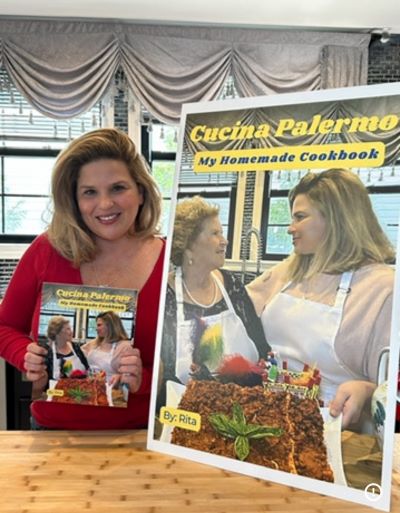
Rita Prisco with her first cookbook
You're now also a published author. Tell us about that experience.
It took a year of people telling me, "You should have a cookbook." And that was another thing that was out of my league mentally. Never in a million years did I think that I would be able to do that!
I spoke to publishers who were reaching out to me, and it was very intimidating. I didn't want the whole process of writing the cookbook with a publisher. I didn't want any part of it. It was too professional. That's not me. I'm not a chef. I'm not a writer. I'm just a wife and a mom who learned how to cook from her mom and her grandmother. I'm just doing those recipes and having a professional cookbook with professional photos and writers and bloggers, and all that was not a representation of who I am.
So I said to myself, if I'm going to do it, I'm going to do it my way. I called my first cookbook My Homemade Cookbook because I didn't want to compete with professionals and be criticized. So, I just laid it out there from the beginning.
I did it at home with my daughter, and I warned everybody that that's what they were going to get. So if they were looking for anything different, look someplace else, not in my book. And that's another thing that people enjoyed and were drawn to. They were like, "Wow, that's what we want. We don't want a professional cookbook."
How many cookbooks do we have in our house that we never use? Because the minute you open them, they're so intimidating, like, "Oh my God, is this the Bible? What are we doing here?" It's like too much.
I did my second cookbook because there are so many recipes. I do 50 at a time; it's what I can handle.
Then, when I saw the response that I had from people, the connection… I always dreamed of writing a children's book about my childhood and growing up with Sicilian parents in America. But obviously, that couldn't have been done because without a following, without people knowing who you are, it's hard to start writing a book, and then who will buy it if you don't have the exposure.
Once I had the exposure, I saw I could do it. So that's where Piccola Francesca came in, and I'm so proud. I feel like I'm more proud of it than I am of my cookbooks because Piccola Francesca is a story of my life. And it's going to continue. That was the first of many to come.
It's been amazing with that book because so many people also related to it. And you don't only have to be Italian or Sicilian to relate to it. It's something that other cultures could relate to.
So many schools are calling me; they want me to come read. And I've been doing that.
How has your Sicilian heritage influenced your cooking and the recipes you share?
They're the recipes that my mom made growing up: peasant food. My mom grew up during the Depression, when there was no steak. It had to be a holiday to have meat. So there was a lot of pasta and potatoes; everything was made with homemade flour. They would turn a piece of old bread into a dessert. (I have one recipe in my cookbook where you take stale bread and turn it into a cookie.)
When I was growing up, my parents weren't poor the way they were when they grew up. They had money, but it didn't matter because even though it was peasant food, per se, it was food that we loved that was delicious, like beans, lentils, and split peas.
And the same thing with my kids. If you introduce these foods to your children from when they're born, they grow accustomed to them. So that's what happened to me.
Which of your recipes has received the most attention, and why?
There are a few recipes that have exploded. My first one has over 5 million views. That's my spagetata. People were shocked that you can make delicious pasta like that with just a few ingredients. It costs almost nothing to make. Every region makes it its own way. They put a little twist to it, and it's theirs. So, that is a staple in all of Italy.
Another one of my recipes that just blew up with millions and millions of views was my chicken cutlets. I think that those weren't as traditional. What happened is that I have a different way of cutting a chicken cutlet, which is fork tender because you're cutting against the grain. And nobody ever saw that in their life.
You would think a butcher would know this. I actually now have a butcher in my town who takes orders of chicken cutlets "Rita's way," cut the way I cut them because when you cut a chicken cutlet my way, it becomes so tender, and it's so much better. And now they know and say, "We would never cut chicken cutlets the way we used to."
People also love my pasta dishes. My pasta dishes all go viral because there are only three or four ingredients. And people like simplicity. They're tired. They work very hard. And if you can make their life easier, they could feed their family without the extra work. That's what they're looking for.
That's what I focus on every day. When I know I'm going to show somebody a recipe, I ask, "Is this going to make their life better and easier?" And that's all I'm going to do. Can I make complicated stuff? Of course. But I don't even show that to people.
My mom's fig cookies for Christmas take hours and hours of work, but I made a recipe that tastes just like my mom's fig cookies, and it's done in a half hour. That's what I look for when I'm looking for a recipe. I'm looking for something simple with a few ingredients that's going to taste good. It has to have those three components. And I feel like once you have those three components, you have a winner.
What are your plans for future projects?
I'm going to continue putting out a new children's book, always with the same character. I'm going to focus on Francesca. I want to introduce other stories of growing up with immigrant Sicilian parents and the differences between that and being an American child with American parents and grandparents. So many things make us different, including our traditions. And I have a lot of stories from my childhood.
What has been the most rewarding part of your journey?
I think the most rewarding part for me is the people who reach out to me. I try my best to read as many comments and emails as I possibly can. I have people who are in hospice. I have people fighting fourth-stage cancer that I communicate with often who tell me that while they're doing their chemo, they watch me, and it brings a smile to their faces. The fact that I could distract somebody a little from their suffering, even for those few minutes, is all worth it to me.
So many people lost their moms or their grandparents at a younger age. They miss their grandmothers or their moms who used to cook for them like this, but they never thought of writing things down. I'm giving them recipes for food they never thought they would make, and they're so happy because I remind them; I bring them memories of their childhood. That is the most rewarding thing in the world.
@cucinapalermo Make spagetata with me!🇮🇹 #fyp #foryou #foryoupage #cooking #italiancooking #pasta #goodeats ♬ original sound - Rita
If you enjoyed this article, consider subscribing to my newsletter for more content and updates!